Please consider this edition of the WeekInSound blog as a not-very-festive communication offering all our readers the compliments of the season. Enjoy!
First Word
With the festive season looming over us all, I’ve decided not to try and match last year’s attempt at finding six Christmas songs that aren’t Mariah Carey or Slade. So this is a ‘normal’, tinsel-free WIS, which is maybe no bad thing given how Christmas-obsessed everything seems to be at the moment.
However, for some reason, I have ended up producing probably the least diverse selection of six tunes that have ever appeared on the blog. Taken from my comfort zone of the 70s and the first half of the 80s, all the artists are UK-based white males mostly playing guitars and generally in a rock-type style. There is still some light and shade to be found in the tunes, but those who enjoy the normal genre-hopping are as likely to be disappointed as I am in myself. Must try harder…

Orchid Girl – Aztec Camera (1982)
This is a throw-back to my gushing fanboy piece on the Bluebells gig in Dunfermline in last week’s blog. Whilst it was great to have a chat with the three core members of the band in the bar, the person I was really keen to talk to was Campbell Owens, original bass player with Aztec Camera, a band I’m even more fanboy of! I caught up with him outside and we chatted for a while about his early days playing with Roddy Frame. Hopefully I wasn’t too gushing, but I did enthuse about his incredible basslines on their brilliant first Postcard single Just Like Gold b/w We Could Send Letters. His modest response was “Thanks – there were a lot of notes on those songs, weren’t there?” Never released digitally I can only point you at the two YouTube links above to hear Campbell’s bass playing on both sides of the single.
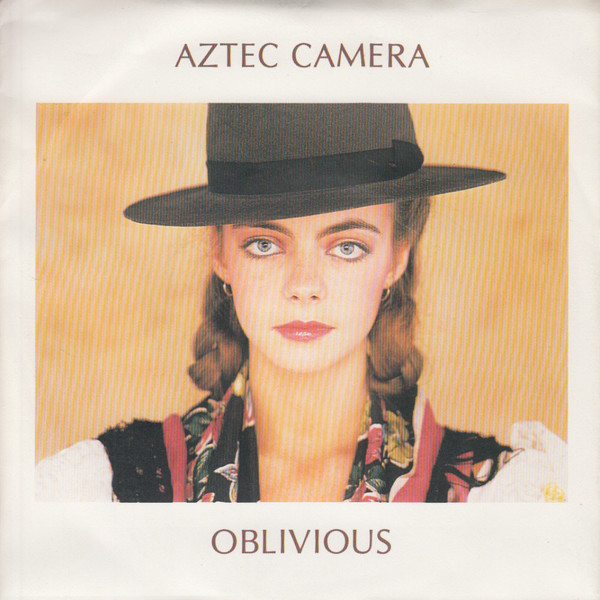
I wanted to playlist something available on Spotify from that early period before the debut LP High Land Hard Rain, and the beautiful Orchid Girl fits the bill. It was one of the songs on the early Green Jacket Grey demo recordings I got a hold of – see WIS 21Apr23. And, when it appeared on the b-side of breakthrough single Oblivious, the recording maintained the stripped-back feeling of the demo. I’ve used both sides of the David Band 7″ single sleeve above as the photo of Campbell and Roddy together on the back is great. In the song, Campbell’s bass is to the front of the mix and Roddy’s melodic vocal line is just terrific – I love the way he sings: “You’re getting soaked I’m angry and my fists are pocketed”. During the introduction to the song at the HLHR 30th anniversary show in Glasgow in 2013, he claimed he was attempting to merge the sound and influences of American jazz guitarist Wes Montgomery with those of Joe Strummer. I think you can hear what he means as the last chorus builds to the end.
My conversation with Campbell turned to the first time I saw the band which was when they got a support slot at an Orange Juice gig in Night Moves in Glasgow in 1980. To avoid him thinking I was a mad nerd, I didn’t tell him that about 25 years ago I had burned an early-period Aztec Camera compilation CD using the aforementioned demo tape, my three Postcard vinyl singles and about five songs off HLHR. I called it Grab That Gretsch and even created a CD jewel case insert (nicking another David Band Aztec Camera artwork) and wrote my own comprehensive sleeve notes. I made some copies for friends at the time and you can see the sleeve ‘Discogs style’ at the link at the top right of the page if you are sad enough to be interested. The opening para of the notes describes the impact that Night Moves performance had on me and the final sentence reads: “Many hours later as I walked home falling and laughing to a friend’s flat in the West End, it was the chorus of Orchid Girl that kept running around my head.”
Spanish Bombs – The Clash (1979)
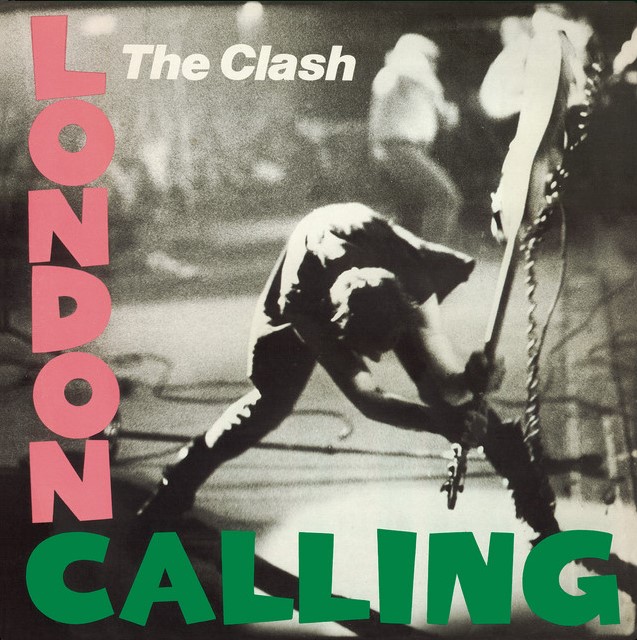
Yes, it’s another Clash track on WIS but with London Calling marking its 45th birthday this week, I really didn’t have a choice, particularly with the link back to Roddy Frame’s comment on Joe Strummer above. There have been veritable oceans of words written about this record in those 45 years and I will only offer a few of my own. Although, finding something new to say about it is tricky. Take cartoonist Ray Lowry’s cover artwork – surely everyone knows the logotype is based on Elvis Presley’s 1956 self-titled debut album? And the iconic image of Paul Simonon smashing his Fender Precision Bass on the stage of the Palladium in New York was taken by NME staff photographer Pennie Smith? No – you didn’t? Well, you do now.
Following the amphetamine-fuelled punk rush of their self-titled debut LP and the polished-up international rock sound of their second album, London Calling was the point at which the band abandoned their year-zero approach and embraced a diverse range of musical styles. And in doing so, they created their masterpiece. The band’s interest in reggae and ska was obvious from the start through covers of Police & Thieves and Pressure Drop. But London Calling also referenced rockabilly, New Orleans R’n’B, jazz and pop. And all under the ‘control’ of infamous Mott the Hoople producer Guy Stevens, whose ‘unconventional’ chair-hurling techniques the band loved but the record company hated.
It is such a wide-ranging record and one that I know so well. Hence it gives me a major challenge to choose what to playlist. The iconic apocalyptic title track and Guns of Brixton are too obvious for WIS. Obviously! As are the tracks that are similar in sound and approach to four of the six Clash songs already playlisted on WIS – I’m thinking the swashbuckling Clampdown or Death or Glory. I was considering going off-piste and choosing The Right Profile, Strummer’s brass-filled ode to Holywood, seen through the drugged-up eyes of Montgomery Clift. Or even further off-piste by picking The Card Cheat from the end of Side 3. I love its unfulfilled ambition with long-time Mott fan Mick Jones trying to use hired-hand Mickey Gallagher’s piano and the Irish Horns to create another Stevens-produced track that Ian Hunter might have sung.
But in the end, I’ve opted for the opening track on Side 2. The stirring Spanish Bombs is a Strummer composition but has vocals from both the writer and Mick Jones, set to a great catchy pop melody. The band’s electric guitars are toned down in the mix and acoustic guitars share the stage, although Jones still throws some great lead riffs in there. Strummer was inspired to write the song by the late 70s Basque separatist bombing campaign targeted at the flourishing tourist resorts in a relatively newly democratic Spain. Lyrically, he juxtaposes references to these events with those of the Spanish Civil War, mixing them with contemporary tourist images: “Spanish weeks in my disco casino, the freedom fighters died upon the hill”. It’s not quite For Whom The Bell Tolls and the Spanish bits are a bit linguistically mangled, but it all sounds fantastic.
American Squirm – Nick Lowe (1978)
This week, I finally finished reading Will Birch’s excellent biography Cruel To Be Kind – The Life & Music of Nick Lowe. Birch was formerly drummer and songwriter with pub-rock band The Kursaal Flyers and then went on to form power-pop group The Records. He moved into journalism and wrote a book on the 1970s pub-rock scene as well as a biography of Ian Dury. So he was well-placed to paint a picture of Lowe’s long musical life. The book is exhaustively researched and is full of great anecdotes on Lowe from those he played and wrote with as well as those who he produced. One of the most surprising things I learned about Lowe’s role in the studio with other bands, is how much his production relied on his people skills rather than his technical skills at the desk. He saw that his job was to coax the performances from the artists and leave the mechanics of the recording to the sound engineer. There is also a good bit of Lowe talking in the book, wittily reminiscing with the benefit of distance from the events and offering up some, often self-critical, insight based on his experiences. It’s fascinating stuff and is heartily recommended.
It is clear that as a songwriter and musician, Lowe is held in high esteem across the industry, particularly in America where his role in that ‘new wave’ of music that crossed the Atlantic in the late 70s is seen as key. He was booked to support Wilco on their 2011 US tour due to the band’s fondness for his work and would join them on stage to play a couple of his tunes like Cruel To Be Kind or I Love My Label. The latter is Lowe’s slightly cynical “jingle for Stiff Records” where he began his solo career after Brinsley Schwarz split up. At the time, Wilco had just launched their own record label, dBpm Records, and their first single released on dBpm had their version of I Love My Label on the b-side.
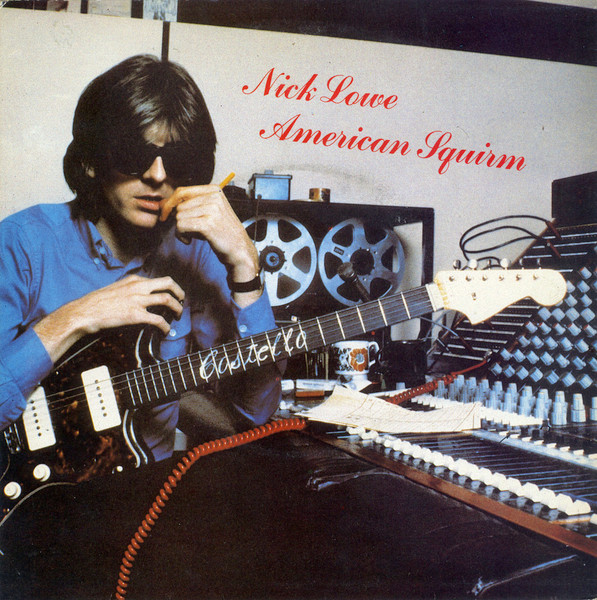
A fan from Lowe’s Brinsley days, Elvis Costello was delighted when Stiff put Lowe in the producer’s chair for his debut LP My Aim Is True. He was to remain there for the next five consecutive releases with The Attractions. In 1977, Lowe was with the band in the US supporting the American release of the first LP and was in the NBC Saturday Night Live studio when they pulled the stunt on the programme by stopping the rehearsed song and blasting out their new as yet unrecorded tune Radio Radio – see WIS 26Jan24. The TV production people went daft at losing all their timings and camera angles and Lowe was so delighted by “all those hipster New Tork types running around like headless chickens” that he went back to the hotel and wrote American Squirm: “I made an American squirm/And it felt so right/On the screen was the comical turn/Deep, deep into the night”. The song was released as a single in October 1978 and while my purchase of a copy was partly driven by the tune on the a-side, the one on the b-side was of interest too. Billed as being by ‘Nick Lowe and his Sound’, it was a version of What’s So Funny About Peace Love and Understanding, Lowe’s forgotten tune from the last Brinsley Schwarz album in 1974. The clue to who was actually performing the track, and would go on to make it a live staple of his sets for the next 45 years, is on the Fender Jazzmaster guitar Lowe is cradling on his lap on the sleeve of the single.

Levi Stubbs’ Tears – Billy Bragg (1986)
Back in WIS 16Aug24, I wrote a piece on Billy Bragg’s great re-make/re-model of Walk Away Renee which had been a hit for The Four Tops. I illustrated the August post with the above image as the track was on the b-side of this terrific top thirty single from 1986 – it made No29 but they all count. I noted my enthusiasm to get the a-side on the blog at some point and Billy Bragg being born 67 years ago this week gives me the perfect excuse to finally playlist his greatest song, Levi Stubbs’ Tears.
The single was released in June 1986 and later that year was included on his “difficult third album”, as the cover of Talking With The Taxman About Poetry subtitled it. After two raw albums of his characteristic solo guitar and vocal recording style, Taxman began to introduce a wider instrumental palette to his songs which would fully flourish on 1988’s Workers Playtime LP. The arrangements on Taxman remain purposefully spare though and Levi Stubbs’ Tears leans towards his signature style. However, there is some percussion in the background and the outro to this incredibly moving song features a suitably haunting flugelhorn part played by Dave Woodhead.
My memory tells me that in interviews at the time, Bragg said he had been taken to a Four Tops concert as a youngster and Levi Stubbs was putting so much emotion into his singing that he could see the tears rolling down his face on stage. If true, it’s an image that resonated with him and he used it at the heart of this desolate tale which he later told an interviewer was created using “Bruce Springsteen’s approach of taking a character and walking them through a situation”. Apparently, once he had that incredible opening line “With the money from her accident she bought herself a mobile home”, it all flowed from there. I defy anybody who hears that line not to be intrigued by what came before and what happens next.
At this point, I would normally start going on about the genius of the lyric and the imagery created but I’m going to leave that to someone else who has done this far more accurately and eloquently than I can ever do. A friend of mine called Phil Adams, who I haven’t seen for a number of years, was co-editor of an online publication called A Longing Look. Named after the line in the chorus of Elvis Costello’s Every Day I Write The Book, he and his co-editor James Craig published articles they called ‘Love Letters’ to the lyrics of songs they liked. In August 2016, Phil was at the Edinburgh Book Festival where Billy Bragg was talking about his lyric book A Lover Sings. I was there too and got my copy of the book signed. At the end of the month, Phil published a brilliant article on Levi Stubbs’ Tears which says more about the beauty of the song than I could ever hope to do. I strongly encourage you to read it at the link here – you will not regret it. In fact, if your time is such that you have to choose between reading the rest of this blog or reading Phil’s piece, then you should click the link!
For my part, I’m just going to include the fantastic lyric from the bridge of the song, where Bragg effortlessly nails the redemptive power of music. I love the way he adopts the often…erm… unsung names of the Motown songwriters who wrote for The Four Tops to make his point:
“Norman Whitfield and Barrett Strong/Are here to make everything right that’s wrong/Holland and Holland and Lamont Dozier too/Are here to make it all okay with you”
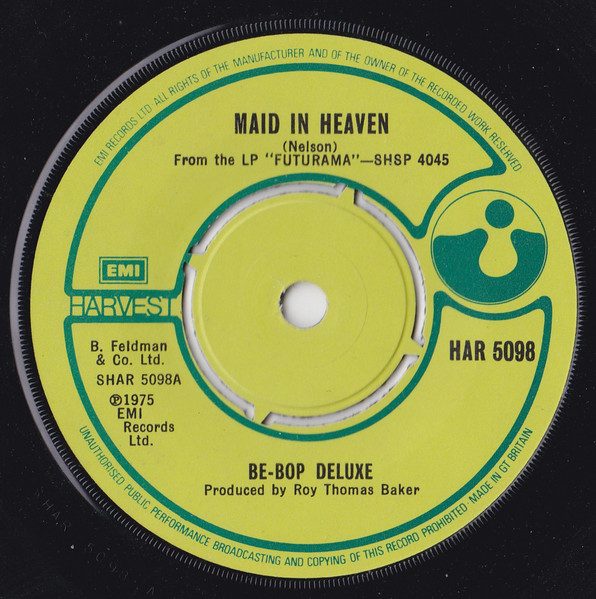
Maid In Heaven – Be-Bop Deluxe (1975)
When the big list of musical birthdays threw me the name of Bill Nelson this week, I went tumbling back in time to that period in the 70s where rock music was transitioning between glam and punk. Nelson, who was 76 on Thursday, was the founder, writer, singer and, most importantly, the guitarist for Be-Bop Deluxe who formed in Wakefield in 1972. I say ‘most importantly’ because make no mistake about it, Be-Bop Deluxe were a guitar band. Their first LP was titled Axe Victim with a cover that merged a skull with the body of a guitar, or ‘axe’ as Spinal Tap might have said. Their second LP was named Futurama, although possibly not after the affordable late-1950s solid-body electric guitar sold in the UK before Gibsons and Fenders arrived from the US. However, there is no mistaking the guitar reference in their third LP Sunburst Finish, which was a variable dark to light colouring used commonly on the bodies of Les Paul and Stratocasters.
A dip into any of those three records would reveal Nelson’s virtuoso playing style, fast and slick over the fretboards which was very much the way you proved yourselves in those days. I’m pretty sure I was introduced to the band by my school pal Davie Ross and at one point in my life I had a taped copy of the Futurama LP, probably copied from his copy. When I listened to it for the first time in nearly fifty years this week, I knew there would be a lot of lead riffs but I was still quite struck by how much soloing went on. Having started at the tail end of glam and prog and finished up five albums later in the brave new world of 1978, their music certainly evolved. But, at all times, it retained that ‘serious muscians’ tag, generally with long-ish complex songs. They had one top thirty hit single, the catchy hook-chorused Ships In The Night taken from their third LP which reached No23 in 1976.
I am going to return to Futurama from 1975 to playlist the great single that was nearly a hit from that LP. Maid In Heaven is a tightly written tune performed in just under 2 minutes and 30 seconds with a terrific ending and absolutely no fat in it whatsoever. It rocks like an artier Thin Lizzy and there is so much going on in the instrumentation. Most importantly, it contains a unique musical hook in the opening verses where Nelson fast strummed his muted strings, briefly creating a fabulous wacka-wacka-wacka sound. I can still picture all of us third-year air guitarists playing along to that bit in the boy’s cloakroom on the rare occasions when it came on the clandestine transistor radios we had there. When I played the song in the car this week, I instinctively adopted that pose and nearly drove off the road.
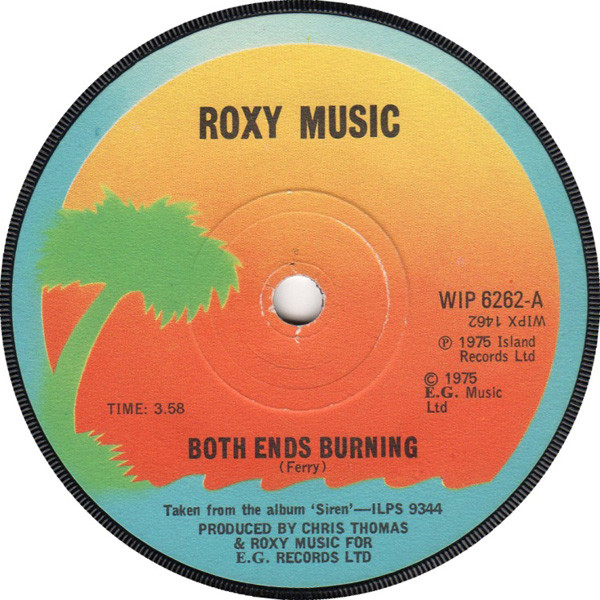
Both Ends Burning – Roxy Music (1975)
When this last song to be chosen popped up as being released this week in December 1975, I felt that it matched the unofficial ‘theme’ that had been slowly developing over the previous five tracks. However, while they tick the nationality, race and gender boxes, it is probably a bit of a stretch to describe Roxy Music as “guitar rock’ of whatever style. There is no doubt that guitars were involved in their music – indeed the band’s guitarist Phil Manzenera is considered to be a very accomplished player. It’s just that with Roxy, it was always so much more than just guitars.
By 1975, Roxy Music had come some way from the band I first discovered in the summer of 1972 in the bedroom of a guy called Johnny Parsons who lived next door to my school pal Mike Clark. Johnny’s family had just moved in and, although he was a couple of years older than us, we hung out together that summer. He took us to his room to proudly play us his new record which turned out to be the self-titled debut LP by Roxy Music, complete with its gatefold sleeve. As our 12-year-old ears struggled to find the pop hooks in the avant-garde music, we stared in wonder at the images of the band where Eno looked like something from outer space. By the time of their fifth LP Siren, Eno was long gone and Roxy had developed a more commercial sound, receiving wide critical acclaim for their four albums, which gave them commercial success through a series of five hit singles. The latest of these, Love Is The Drug had preceded the Siren LP in September 1975 and reached No2. It looked like they were unstoppable.
However, as a follow-up, Both Ends Burning struggled to replicate the first single’s sales and peaked at No 25. The band toured the album in 1976 but the pressure of delivering so much in three years began to show and the band went into a three-year hiatus until 1979. But, despite its chart position, Both Ends Burning saw them end the first phase of their career with a bang. Its attacking mix of Eddie Jobson’s layered, pulsating synths allowed Brian Ferry’s impassioned vocal and Andy McKay’s saxophone riffs to drive the song forward. I’ve chosen to playlist the five-minute album version of the song as the single mix edited the intro and Manzanera’s dramatic guitar solo at the end, which wails away behind Ferry’s voice. We couldn’t miss the guitar out, could we? Not this week at any rate. There’s a great film of the band performing it live at Wembley in October 1975 with Manzanera on his Firebird and Ferry the very epitome of cool, rocking a GI shirt and tie combo as he sang.
Last Word
As well as swerving the Christmas tunes, I’ve also decided that WIS will not publish on Friday 27 December while everybody, including myself, recovers from the overeating and overdrinking of the week. There are too many other distractions at this time of year. However, the following week, the WIS Tracks of 2024 edition will land in your in-boxes and on your socials at 5pm on Friday 3 January, by which time the carnival will be well and truly over.
Also, I hate to sound like Kier Starmer but I am planning a 2025 re-set on the blog. The aim is to reduce the written content a bit for the new year ahead. Sometimes (most of the time?), I don’t really know when to shut up and the last few weeks have seen blogs loaded with more and more words as, like Magazine’s light, they pour out of me. It takes too much of my time to write it and, I fear, too much of your time to read it all and is probably putting you off doing so. Starting in the first full week of the new year, I’m going to try to keep it leaner and keener. We shall see how long that lasts…
Finally, topped up with this week’s tracks, the Master Playlist passes the 550 tunes mark – really must think how to make it more manageable…
AR
If you enjoyed this, there is plenty more where that came from. Subscribers receive a link in their inbox every Friday evening at 5pm UK time. You can’t start the weekend without it.


Leave a comment