The end of March brings the hope that Spring has arrived but here are six tunes to keep you warm if that proves not to be the case. Enjoy!
First Word
Over the last few weeks, my drive for brevity has slowed down and I have slipped back into the habit of too many words taking up to much of my time, and yours too! This week has been a busy week on other things, so you’ll be pleased to see the word count has dropped back. Slightly!
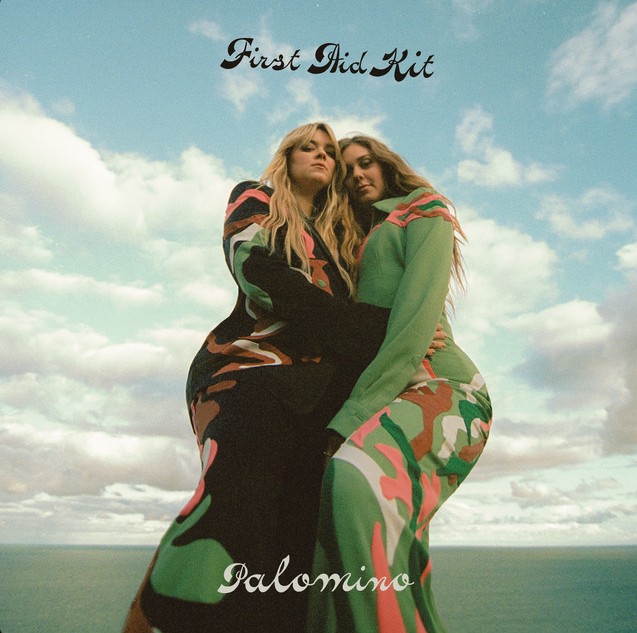
Wild Horses II – First Aid Kit (2022)
I’m opening with a throw-back to last week’s theme of songs with band names in the title. This track fell at the first hurdle as it doesn’t reference a band name, rather it adopts the title of a song recorded by two artists whose name appears in the chorus. The original Wild Horses was written by Keith Richards and Mick Jagger and appears on Sticky Fingers released by The Rolling Stones in 1971. The song was actually written in 1969 during the recording of Let It Bleed, a time when Richards’ writing was being heavily influenced by his friendship with country-rock singer and fellow drug-addict Gram Parsons. Parsons had played with The Byrds but had formed The Flying Burrito Brothers with Chris Hillman in 1969. As Richards thought his band were not interested in recording the song, he sent the Stones’ demo of Wild Horses to Parsons, the day after the infamous Altamont Free Concert. The Flying Burrito Brothers recorded it with Parsons on vocals and released it on their second LP Burrito Deluxe in April 1970, some 12 months before the Stones recorded it.
Johanna and Klara Söderberg of First Aid Kit are huge fans of Gram Parsons (apparently Klara has a GP tattoo!) and they wrote this ‘song within a song’ for their 2022 album Palmino. It’s a great break-up track featuring a couple on a road trip, realising their incompatibility means their relationship is nearly over: “And then we got hungry, stopped at a diner/You flirted with the waitress and I didn’t even care”. It is a beautifully constructed song, with the instrumentation building throughout and, of course, those gorgeous harmony vocals. “We played Wild Horses on the car stereo/You prefer the Rolling Stones’ and I like Gram’s”
Parsons died of a drug overdose aged only 26 in the Joshua Tree Inn in 1973. Incredibly, 81-year-old Richards is still with us.
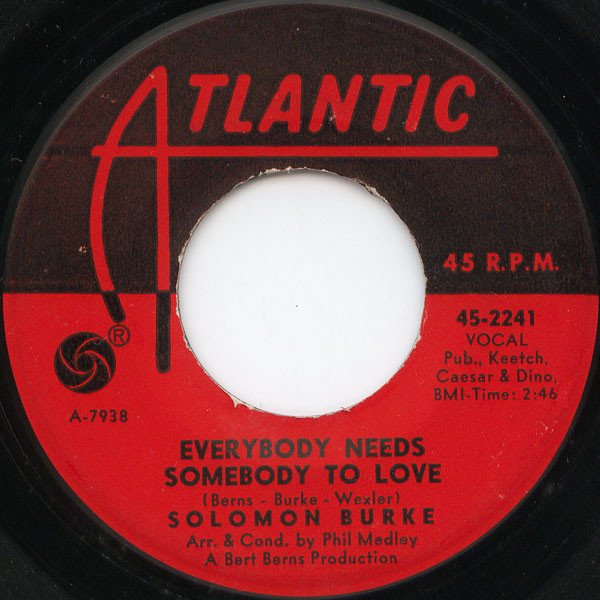
Everybody Needs Somebody To Love – Solomon Burke (1964)
Born this week in 1940, Solomon Burke can lay claim to being one of the founding fathers of soul music – indeed, he is credited with coining the term. However, despite his prodigious output over his long writing and recording career, Burke had relatively few major hits under his own name, so history tends to overlook his contribution to the genre. He began recording with Apollo Records in 1955 but he moved up a gear in 1960 when producer Jerry Wexler and owner Ahmet Ertegun signed him to Atlantic Records.
Initially Burke’s gospel upbringing made him nervous of being marketed by Atlantic as a R&B singer as rhythm and blues was seen as the ‘Devil’s music’. But his love for the secular sound resulted in him bridging the gap between gospel and R&B, and he became one of the first artists to be referred to as a ‘soul singer’.
If there was one song that highlighted how underappreciated Burke is, it is Everybody Needs Somebody To Love. Burke wrote it in 1964 but was talked into sharing writing credits with Wexler and producer Bert Berns. Burke arranged the tune with a swinging gospel chorus, rasping R&B horns and with himself leading it off in the style of a ‘preacher’ with his congregation. Wexler and Berns insisted that it wasn’t a hit and they were right – it was issued as a single and didn’t sell. That is, until Wilson Picket covered it in 1966 (with a reference to “Brother Solomon Burke” in his intro) and Picket’s version made it into the US top thirty.
The song has gone on to have a life of it’s own – most famously when sung by John Belushi and Dan Aykroyd as The Blues Brothers in the movie of the same name. The Rolling Stones were big fans of Burke and included their version of the song on their second album in 1965. Led Zeppelin were also Burke fans and used the tune in a medley when playing Whole Lotta Love live. And the Small Faces borrowed from it heavily in the development of their debut single Whatcha Gonna Do About It. When Burke died in Nov 2010 aged 70, Mick Jagger performed Everybody Needs Somebody To Love at the Grammys in 2011 to mark the passing of the great man.
Behave Myself – She Drew The Gun (2022)
A couple of weeks back I came up with the idea of throwing a ‘New To Me’ track into the blog when I playlisted 170 by Anna Erhard who I knew nothing about but I liked the song when I heard it. It seemed to go down well (my Frankfurt-based reader liked it anyway!) so here is another New To Me track this week.
On Tuesday night, Lynn came along with me for her first taste of Public Service Broadcasting playing live, this time at the Usher Hall in Edinburgh. Despite the slightly muddy sound quality (which sadly overpowered the key sample dialogue at times), the band were on magnificent form. We managed to catch a slightly earlier train and so ended up sat in our seat (hey, we’re not getting any younger!) with a drink when the support band She Drew The Gun took to the stage. Half an hour later, we turned to each other and said “Well, they were great”.
T’internet tells me the band are a politically-motivated three-piece from the Wirral in the North West of England fronted by singer/songwriter Louisa Roach. They’ve been releasing records since 2013 and won the Glastonbury Emerging Talent award in 2016. Louise has an ear for a psych-pop tune with some electronica and Scouse poetry added to the mix, just to keep it interesting. With drums, bass and guitar supplemented by a synth for loops and beats, they made a fair old noise and quickly won the crowd over with their melodic but quirky songs. I’ve playlisted the title track to their 2022 album Behave Myself – the day-glo video for the tune shows Lisa playing a pink acoustic guitar with the lyric “I am the space for the rebel to revolt in” written on it, Woody Guthrie-style. They played this song on the night along with selections from their November 2024 LP Howl, which I have been listening to this week. Not sure if She Drew The Gun will…erm… hit the target in Frankfurt but I’m sure John will offer a view!
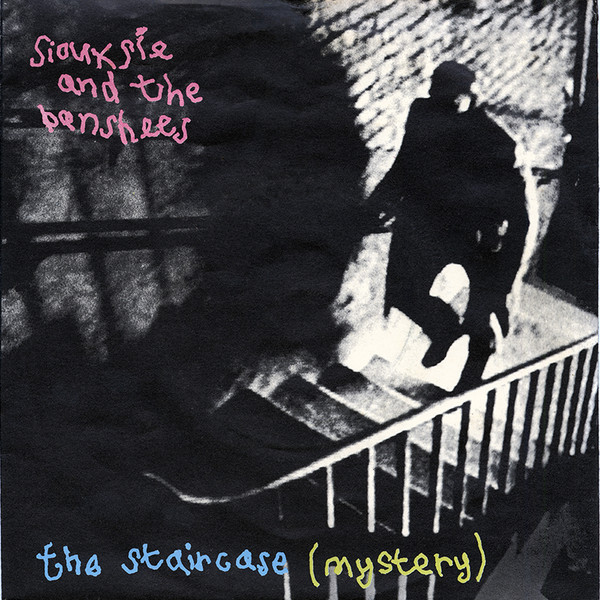
The Staircase (Mystery) – Siouxsie & The Banshees (1979)
46 years ago this week in March 1979, Siouxsie and the Banshees released the follow-up single to their surprising top ten hit Hong Kong Garden. As was common in those days, The Staircase (Mystery) was a stand-alone single not included on their pioneering post-punk debut album The Scream which had been released in November 1978. I purchased all these records at the time and found them to be an exhilarating listen, if a little stark and almost harrowing at times. This certainly wasn’t Sham 69!
Central to the revolutionary sound of that LP, and to this single, was the distinctive metal-shard roar of John McKay’s guitar. Yes, Siouxsie had a brilliantly unorthodox vocal style and the bass and the toms thump away gloriously, but their early sound was defined by the way that McKay’s guitar slashed through the mix at you. For someone who was self-taught and had no conventional skill as a guitar player in playing standard chords and lines, the sound on these recordings has been hugely influential in how ‘rock’ music developed in the 80s. His use of unusual chord structures fed through effects pedals to vary the texture of the music was much admired by the likes of Johnny Marr and John McGeoch of Magazine, who went on to replace McKay in the band when he left after recording the Banshee’s second album. Years later in 2012, Roddy Frame wrote this lyric for his song Worlds in Worlds: “I close my eyes and I drift on a terrible, beautiful sound like John McKay’s on The Scream and I dream and I rise”.
McKay’s departure from the group was sudden due to a fall-out he and drummer Kenny Morris had with Siouxsie at a record signing in the Other Record Shop in Union St in Aberdeen in Sept 79. The gig that night was cancelled, as was the next night’s gig in the Glasgow Apollo that I had tickets for. Without t’internet, we only found out when we turned up at the venue – I was gutted. Apart from a brief flurry in the mid-80s with a band called Zor Gabor (no, me neither), McKay completely disappeared from music, working in the fashion business. However, there is news of an album release next month where songs he recorded with Morris just after he left the Banshees are to be aired. Lead track Flare was released in February and is an interesting historical listen, if lacking in a Siouxsie vocal!
Banshees fans might like the post I did on Spellbound back on WIS 29Sep23 where I wittered on about Steve Severin’s unusual bass playing style – they truly were an innovative band.

Trans-Europe Express – Kraftwerk (1977)
On his guest blog a few weeks ago, my Adelaide-based friend Michael Lynch had a wee pop at the lack of electronic music on WIS. So when I spotted that it was 48 years ago this week that Kraftwerk released their hugely influential sixth album Trans Europe Express this seemed to give me the chance to right that particular wrong. Also, my friend Fiona is shortly setting out on a rail trip across Europe so playlisting the wonderfully evocative title track seemed right.
The LP was recorded in the brilliantly named Kling Klang studio in Düsseldorf, and it sees the band begin to focus on minimalist sequenced rhythms. The recordings used a Synthanorma Sequenzer, a new analog sequencer manufactured specially for the band, removing the chore of playing repetitive keyboard patterns. The title track is part of a longer suite of music on the second side of the LP. It was written after members of the band met David Bowie and Iggy Pop, hence their appearance in the lyric and the reference to the Station to Station album. Many critics consider it to be the band’s definitive song, blending their key interests of transport and technology.
Trans-Europe Express was the first Kraftwerk album to be mixed in two entirely separate versions, one in German, the other in English. The German LP sleeve featured a monochrome portrait by New York photographer Maurice Seymour. However, the UK and US releases used a highly retouched colour photo-montage of the group by French photographer J. Stara. In both photos, they are dressed in suits to resemble mannequins as per the track Showroom Dummies. They just look so Germanic!
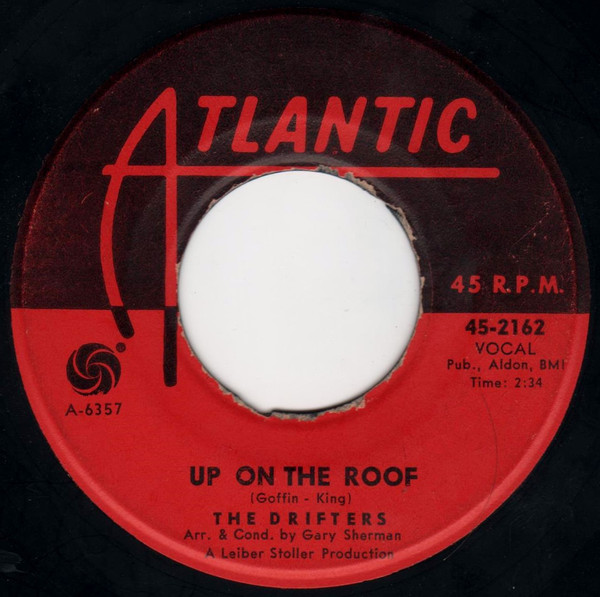
Up On The Roof – The Drifters (1962)
This week’s missive has been bashed out on the laptop to the sound of footsteps and hammering over my head as we are having the roof of our house re-tiled. I knew it was going to be noisy but it has exceeded expectations. And to make matters worse, Lynn had her email hacked on Wednesday so there was a fraught day of calls to the various people on the BT help desk while they tried to lock it down – all to the sound of very loud hammering. The hacker had pissed all over what BT laughingly calls their security protocols and was active in her account for hours altering passwords every time we managed to change them to get back in. Scary stuff.
So a song was required that soothed the collective nerves and what could be more calming than Goffin and King’s Up On The Roof, as performed by The Drifters. Heavily influenced by the rooftop scenes in West Side Story, Gerry Goffin’s lyric paints the roof of a building as a place of sanctuary where “it’s as peaceful as can be” and your “cares just drift up into space”. It’s a terrific piece of writing and Goffin has cited it as his favourite lyric.
It’s the second track this week to be issued on the Atlantic label in the US and it was produced by Jerry Leiber and Mike Stoller and featured Carole King on keyboards. It reached the top five in the States but was eclipsed by a cover version in the UK when Parlophone released Kenny Lynch’s pop version which went into the top ten. There was a second British cover version at that time when producer Tony Hatch somewhat soullessly revamped the song in a Merseybeat style with Julie Grant as the singer. In 1970, Carole King recorded a slowed down version of her song with James Taylor on guitar and the song has been covered by many others. But it is The Drifters’ soulful take that is the definitive recording, in this scribe’s humble opinion.
Last Word
In my failed attempts to resolve the jumbled listing issue with the Blog Summary at the link at the top of the page, I have discovered two new (to me!) features that I have incorporated into the end of this week’s edition. Neither are particularly helpful – the tag cloud doesn’t pick up the one-off obscurities and the search only takes you to a blog listing with no highlighting of the subject searched. But they give the option for poking about in the dusty WIS archive, if anyone so desires.
And there is always the behemoth that is the Master Playlist to wrestle with. Six more songs have (hopefully) dropped in there today.
AR
If you enjoyed this, there is plenty more where that came from. Subscribers receive a link in their inbox every Friday evening at 5pm UK time. You can’t start the weekend without it.
WIS FREQUENT FLIER TAG CLOUD
Allison Russell Amy Winehouse Aztec Camera Billy Bragg Blondie Brandi Carlile David Bowie Eels Elton John Elvis Costello & The Attractions Emmylou Harris Everything But The Girl Ezra Collective Faces Gang of Four Gil Scott-Heron Jason Isbell and the 400 Unit John Grant Johnny Cash John Prine Lucinda Williams Madness Nick Cave & The Bad Seeds Nick Lowe Paul Weller Prefab Sprout Public Service Broadcasting Ramones Sparks Steely Dan Steve Earle Talking Heads Taylor Swift The Beatles The Clash The Cure The Decemberists The Go-Betweens The Jam The National The Rolling Stones The Stranglers The Waterboys The Who Wilco
WIS VAULT SEARCH
 Week In Sound
Leave a comment